

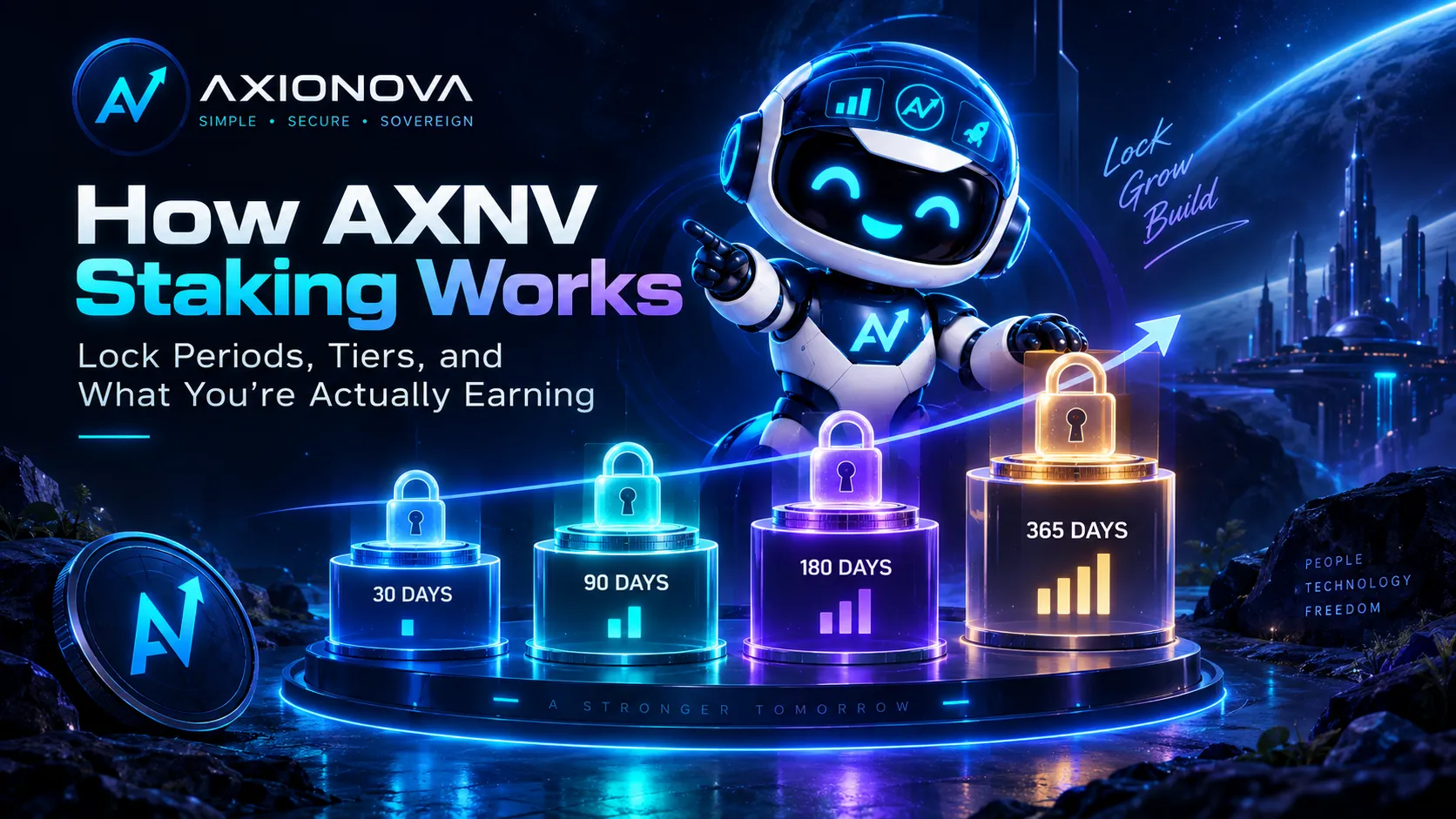
Axionova staking went live before the Token Generation Event, which makes it a little different from staking on most projects: there's no liquid AXNV to stake yet, no floating APY that moves with pool size, and no early-exit button. This post walks through exactly what you're locking, what you're earning, and what "no early exit, for anyone, ever" actually means in the contract.
The Short Version
- You're not staking AXNV — you're staking gAXNV. Specifically, the unclaimed presale allocation sitting in your gAXNV balance. It never leaves your name; the staking contract locks it out of the prediction game and out of your TGE claim for the duration of the term.
- Four tiers, fixed APR per tier: 3% (30 days), 5% (90 days), 6.5% (180 days), 8% (365 days). The rate is set at deployment and locked into your position the moment you stake — it can't change under you later, and there's no owner switch that adjusts it either.
- Rewards are paid in sAXNV, not AXNV. sAXNV is a separate, non-transferable credit backed 1:1 by the 56,250,000 AXNV Staking Rewards allocation — the same allocation named on the tokenomics page.
- It's a genuine hard lock.
unstake()has exactly one condition — the term has to have matured — and reverts before that, unconditionally. There's no admin override that can pay a position out early, even in principle. - Claiming happens at TGE, not at maturity. A matured position returns your principal to your gAXNV balance and mints your sAXNV reward. Both convert to real, wallet-transferable AXNV only after TGE, through the official distributor contract — the same pattern gAXNV uses for game winnings.
- Minimum stake is 1,000 gAXNV, and the official contract is
0xc0ADd9DE9bc39003109A6eD48E03e0114e57683bon BNB Smart Chain — always verify this against the staking page before approving anything.
Why stake before TGE at all?
Normally "staking" implies a liquid token sitting in a pool earning yield you can watch accrue and withdraw more or less whenever you want. That's not what this is. Before TGE, AXNV itself isn't transferable yet — what presale buyers hold is a claim on it, represented on-chain as gAXNV. Staking here is a way to commit part of that claim to a fixed term now, so that the reward is already locked in and waiting the moment real AXNV becomes claimable.
The trade you're making is straightforward: you give up the ability to spend that portion of your gAXNV in the BTC prediction game for the length of the term, and in exchange you earn a fixed, tier-based reward that doesn't depend on how many other people staked, how big the pool got, or how the market is doing that week.
The four tiers
| Lock length | APR | Reward on 10,000 gAXNV staked |
|---|---|---|
| 30 days | 3% | ~24.7 sAXNV |
| 90 days | 5% | ~123.3 sAXNV |
| 180 days | 6.5% | ~320.5 sAXNV |
| 365 days | 8% | ~800 sAXNV |
The reward is calculated the way you'd expect from an annualized rate applied to a fixed term:
reward = amount × tier APR × (lock duration ÷ 365 days)Notice the rate scales with the length of the commitment, not just with time. That's deliberate: restaking the 30-day tier twelve times over a year covers almost the same total time-in-lock as one 365-day position, but at a flat rate it would pay out almost the same reward — removing any reason to prefer the long lock over a string of short ones. Because each tier's APR is fixed the moment you open the position, there's also no risk of a rate change reaching back into a position you already opened.
What "hard lock" actually means on-chain
Some staking products describe themselves as locked but still leave a way out — an early-withdrawal penalty, an emergency-unstake function, an admin override for special cases. Axionova's pre-TGE staking contract doesn't have one. unstake() checks a single condition, block.timestamp >= startTime + lockDuration, and reverts before that with no exceptions — not for the contract owner, not for a support request, not for any circumstance. If you stake for 365 days, that gAXNV is unavailable for 365 days, full stop.
The one lever the contract owner does have is closeStaking() — a one-way switch that stops new positions from opening. It has no effect on positions already open; they mature and pay out exactly as if it had never been called. In practice, this means staking will need to close well ahead of the point where gAXNV itself gets frozen for TGE distribution, so that every open position has time to reach maturity first.
What backs the reward, and why sAXNV isn't AXNV
sAXNV exists for the same reason gAXNV does: it's a credit ledger, not a transferable token, and it's capped so it can never promise more than what's actually funded behind it. Its supply ceiling is set at exactly 56,250,000 — the Staking Rewards allocation from AXNV's fixed 750,000,000 supply — and the contract enforces that cap on every mint. Every unit of sAXNV in existence is backed 1:1 by real AXNV sitting behind it, the same guarantee gAXNV makes for presale allocations.
sAXNV can't be transferred, traded, or used as collateral — attempting to move it reverts. It exists purely to track what you've earned until TGE, at which point balances are frozen and the distributor contract pays out real, wallet-transferable AXNV against them.
Before you stake
A few practical things worth internalizing before locking anything:
- Only stake what you don't plan to wager or need liquid before TGE. There is no partial withdrawal and no early exit — a 365-day position is a 365-day commitment, not a suggestion.
- The reward is fixed-rate, not compounding. Restaking a matured position starts a fresh term at whatever tier you choose next; it doesn't automatically roll over.
- Verify the contract address yourself. Always cross-check
0xc0ADd9DE9bc39003109A6eD48E03e0114e57683bagainst the official staking page or the block explorer before approving or staking — never trust a link from anywhere else.
None of this is financial advice — it's a description of how the contract behaves. Read it, or read the summary above, before deciding how much of your allocation you want locked and for how long.